
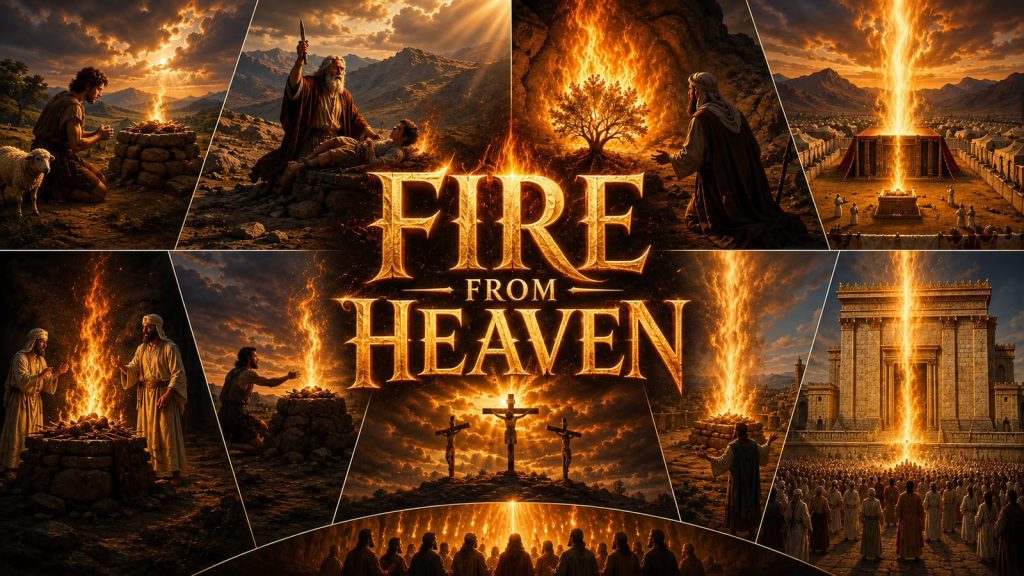
This message series traces the biblical theme of fire from heaven as a revelation of God’s acceptance, presence, worship, calling, and revival. Across the sermons, fire is presented as more than a dramatic sign: it declares that God determines acceptable worship, reveals His holiness, confirms His provision of sacrifice, calls ordinary people into service, and points ultimately to the finished work of Christ. The series repeatedly contrasts human-made religion with God-given worship, showing that faith responds to God’s Word, salvation rests on substitution, reverence must accompany joy, and every calling depends on God’s sufficiency rather than human ability.
2026-08-02
The Fire of Acceptance
This message series topic explains that God alone defines acceptable worship. Through Abel’s offering and Abraham’s sacrifice on Mount Moriah, the message contrasts faith-filled obedience with self-directed religion. Abel’s blood sacrifice is presented as worship offered according to God’s Word, while Cain’s rejected offering illustrates the danger of sincerity without obedience. Abraham’s willingness to offer Isaac highlights worship as surrender and points to substitution, with the ram foreshadowing Christ. The central emphasis is that salvation and acceptable worship come through the sacrifice God provides, fulfilled in the Lord Jesus Christ.
2026-08-09
The Fire of His Presence
This topic focuses on the burning bush as a revelation of God’s holy presence. The fire burns without consuming the bush, showing that God can reveal Himself in ordinary places while preserving what His holiness would otherwise consume. Moses’ encounter teaches reverence, humility, and the seriousness of approaching God rightly. The message also presents the angel of the Lord as a revelation of Christ, connects God’s name “I AM” with His eternal self-sufficiency, and shows that calling follows communion with God. Moses’ weakness becomes the setting for God’s sufficiency, reminding believers that service depends on God’s presence: “I will be with you.”
2026-08-16
The Fire of Worship
This topic examines Leviticus 9 and 10, where fire from the Lord both accepts sacrifice and judges unauthorised worship. Aaron’s offering is accepted because it follows God’s revealed pattern, while Nadab and Abihu’s “strange fire” demonstrates the seriousness of approaching God on human terms. The message teaches that worship begins with sacrifice, not emotion or performance, and that true worship must hold joy and reverence together. Christ is presented as the accepted sacrifice, the true priest, and the only basis on which believers can draw near to God. The practical call is to keep God’s fire burning through Scripture, prayer, obedience, and wholehearted devotion.
2026-08-30
The Fire Of Calling
This topic begins to develop the fire of God’s calling through the accounts of Gideon and Manoah in Judges. The message places both events within Israel’s repeated cycle of disobedience, judgment, repentance, and deliverance. Fire consuming the offerings marks God’s initiative and confirmation of His call, showing that He chooses ordinary and unlikely people for His work. The emphasis is that calling comes from God, not human greatness, and that when God calls, He also enables. The surviving portion especially underlines comfort for believers who feel weak or inadequate: God uses the weak, base, and foolish things so that He receives the glory.
2026-09-06
The Fire of Revival
This topic is only partially present in the current message series text. From the available opening, it continues the “Fire from Heaven” study and recalls the previous themes of acceptance and replacement sacrifice. Because the transcript ends shortly after introducing the topic, the summary is limited to the material currently available and does not infer the full argument or application of the message.
2026-08-02
The Fire of Acceptance.
Maybe one day I’ll do a series on that. So we’re going to start it for the next eight weeks. We’re going to look at fire from heaven. And throughout the Bible, fire represents oftentimes the visible manifestation of God’s presence. Sometimes it speaks of God’s holiness. Sometimes it speaks of God’s judgment. And sometimes it speaks of his acceptance. So tonight we’re going to look at the fire of acceptance. And one of the great themes that runs throughout the whole of scripture is that God is the one who determines the type of worship that he receives.